The annual rental yield on property in Saudi Arabia
2026-09-20
80 Views



Many investors rely on a single number when evaluating a real estate opportunity: the rental yield announced by the developer or broker. The problem is that this number is often a simplified gross yield that does not reflect the actual costs borne by the owner, making comparisons between two different opportunities misleading if the yield is not calculated correctly. In this guide, we clarify the difference between gross and net yield, practical calculation steps, and the factors that actually increase or decrease this percentage in the Saudi market.
- What is the difference between gross rental yield and net rental yield?
- How do you calculate gross rental yield step by step?
- How do you calculate net rental yield more accurately?
- What factors increase or decrease rental yield in Saudi Arabia?
- Rental yield vs. capital growth: which should guide your decision?
- Common mistakes when calculating rental yield
- How can Imtilak Global Saudi Arabia help you?
- Frequently Asked Questions
What is the difference between gross rental yield and net rental yield?
Gross rental yield is the simplest and most common percentage in marketing advertisements. It is calculated by dividing the total annual rent by the purchase price of the property without deducting any operating costs. Meanwhile, net rental yield deducts all actual costs associated with Imtilak of the property and its operation, such as maintenance fees, management fees, and potential vacancy periods.
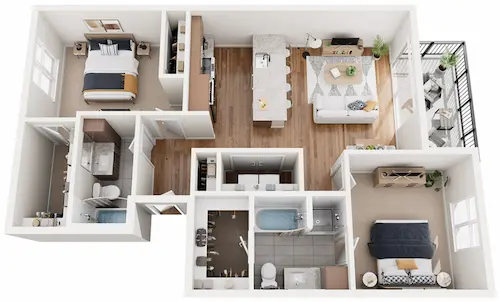
How many living rooms are in the apartment?

The difference between the two figures can be significant. A property marketed with a gross yield of 8% may have an actual net yield of 5.5%-6% after accounting for costs, making reliance on the gross figure alone insufficient for making a well-informed investment decision.
How do you calculate gross rental yield step by step?
The basic formula is simple: (Total annual rent ÷ Purchase price of the property) × 100.
For example, if the purchase price of a residential unit is 800,000 SAR and the expected annual rent is 56,000 SAR (equivalent to about 4,670 SAR per month), the gross yield is calculated as follows:
(56,000 ÷ 800,000) × 100 = 7%
This number gives a quick initial picture to compare different properties, but it does not tell you how much you will actually get in your pocket after costs, which leads us to the next step.
How do you calculate net rental yield more accurately?

To calculate the net yield, you deduct the actual annual costs from the rent before dividing by the price. The most notable of these costs are:
Service fees and maintenance of shared facilities, especially in projects within gated communities or towers with shared amenities.
Expected vacancy periods, as it is rare for the unit to be rented out for a full 12 months every year without interruption.
Property management fees, if you use a property management company instead of direct leasing.
Regular maintenance and repairs not covered by the developer's warranty after it expires.
Using the same previous example (800,000 SAR price, 56,000 SAR annual rent), if we assume total annual operating costs of 8,000 SAR (maintenance, management, partial vacancy), the calculation becomes:
((56,000 − 8,000) ÷ 800,000) × 100 = 6% approximate net yield, compared to 7% gross yield.
Get a free real estate consultation
What is your preferred way of communication? How would you like to be contacted?

Get a free real estate consultation
Choose the appropriate day for us to contact you
This is an illustrative example of the calculation method only, not a figure applied to a specific project. Actual costs vary from one property to another depending on the type of unit, its location, and the market situation at the time of leasing.
Also read: Apartments for Sale in Riyadh
What factors increase or decrease rental yield in Saudi Arabia?
The yield is not determined by the purchase price alone, but by a set of interrelated factors:
Start a chat
Talk to us on your favorite channel







The city and specific neighborhood: Yield rates vary greatly between cities and even between neighborhoods within the same city, depending on the actual rental demand in each area.
Type and size of the unit: Smaller units (studios and one-bedroom apartments) usually achieve a relatively higher percentage yield than larger units, because the rent does not decrease in the same proportion as the area.
Project stage (ready or off-plan): A ready property starts generating rental yield immediately upon purchase, while an off-plan property does not generate any rental yield before actual handover, although it may compensate for this with a lower entry price and a price difference at delivery.
Level of rental demand in the area: Proximity to business centers, universities, and main transport routes increases unit occupancy rates and reduces vacancy periods, which directly reflects on the net yield.
Project modernity and amenities: Modern projects within integrated residential communities (swimming pools, gyms, security) usually attract tenants willing to pay a relatively higher rent compared to a similar unit in an older building without amenities.
Also read: Return on Real Estate Investment in Riyadh
Rental yield vs. capital growth: which should guide your decision?
Some investors tend to focus entirely on the monthly rental yield percentage, while others focus on the expected price difference when reselling later (capital growth). Both strategies are valid, but they suit different goals. Those seeking stable and continuous monthly income usually prefer ready properties in areas with proven and stable rental demand, while those targeting a longer investment horizon often prefer off-plan properties in areas with active urban growth, where the difference between the early booking price and the market price at delivery is the main driver of profit, not the monthly rent during the construction period.
Are you ready to invest? Which apartment type do you prefer?
 Studio
 One bedroom
 Two bedrooms
 3 bedrooms or more
Select region
The best decision depends on your time horizon and need for regular cash flow, not on which is "better" in absolute terms.
Common mistakes when calculating rental yield
Relying on advertised rent instead of actual achieved rent: Some marketing estimates assume a rent higher than the actual average prevailing in the area.
Ignoring vacancy periods between tenants: Assuming full occupancy for 12 months every year without interruption overestimates the actual yield.
Overlooking the real estate transaction tax when calculating total investment yield: This tax is 5% and directly affects the net yield upon sale, even if it does not affect the annual rental yield itself.
Comparing the gross yield of one property to the net yield of another: As if they are directly comparable numbers, when in fact they are two completely different measures.
Ignoring the timing difference between off-plan and ready properties: Calculating annual rental yield for a property that has not yet been delivered, ignoring that this yield will not actually start until after handover.
How can Imtilak Global Saudi Arabia help you?

Accurately calculating net rental yield requires actual data on costs and occupancy rates in each specific area, details that are difficult for an overseas investor to access alone. Our team at Imtilak Global provides you with a realistic analysis of the expected yield (gross and net) for each opportunity in our portfolio, whether you are considering projects in Riyadh, Jeddah, Mecca, or Medina, with a direct comparison between ready purchase and off-plan purchase options according to your investment horizon. You can book a free real estate consultation to review the feasibility of any opportunity that interests you before making a decision.
Frequently Asked Questions
What is the average good rental yield for residential property in Saudi Arabia?
How many living rooms are in the apartment?
The generally acceptable gross yield ranges between 5% and 8% annually, depending on the city, neighborhood, and type of property, with a clear difference between gross and net yield after deducting costs.
Does the rental yield include the real estate transaction tax?
No, the real estate transaction tax (5%) is calculated separately when selling the property and is not included in the annual rental yield formula, but it does affect the total investment yield when calculating the final profit after sale.
Is the rental yield for off-plan property higher or lower than ready property?
Get a free real estate consultation
What is your preferred way of communication? How would you like to be contacted?
Get a free real estate consultation
Choose the appropriate day for us to contact you
There is no single answer. Off-plan property does not generate rental yield before handover, but it may offer a greater capital growth opportunity (price difference), while a ready property starts generating immediate rental yield but usually at a higher entry price.
How do I know the actual expected rent for a specific property before buying?
It is advisable to review actual rental prices for similar units in the same area (same neighborhood and unit type) instead of relying solely on the developer's or broker's estimate.
Do you like this topic? You can share it with your friends now!


Do you like this topic? You can share it with your friends now!
Need real estate help?
Consult with our specialist

Categories