Smart entry system and security in gated communities in Saudi Arabia
2026-09-08
117 Views


Last updated: July 21, 2026 | Prepared by: Imtilak Global Advisory Team
When a foreign investor or resident searches for housing within a gated community in Saudi Arabia, they often ask: Is the security here real and continuous around the clock, and is entry and exit managed in a practical way that does not rely solely on a human guard? The answer to these two questions is determined by a system known as smart access systems, a technology that has become a basic standard in modern residential projects. In this guide, we explain how these systems actually work, the difference between them and traditional security, and how to verify their real presence in any project before purchase.
- What is the smart access system in gated residential communities?
- Key components of security and smart access systems in modern projects
- Why has this standard become essential for expats and foreign investors in particular?
- Demand for smart access and security systems in Saudi Arabia
- Practical difference between traditional and automated security in residential complexes
- How does the system work?
- Applied example from Jeddah and Riyadh projects
- Points to check before buying
- Frequently Asked Questions
What is the smart access system in gated residential communities?
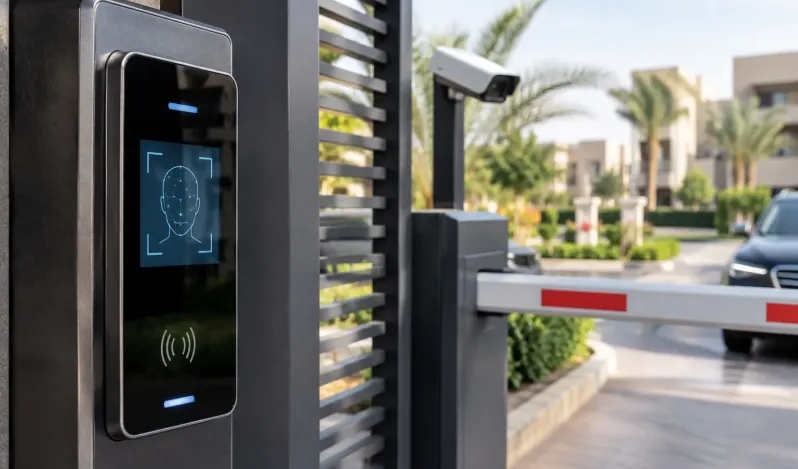
The smart access system is an integrated electronic system that controls entry and exit from the residential complex and from the residence itself, without full reliance on traditional keys or a human guard alone. The system relies on technologies such as electronic cards, access codes via a mobile app, or facial or fingerprint recognition at the main gate and elevators, so that every entry and exit is recorded electronically and can be reviewed later if needed.
How many living rooms are in the apartment?

This type of system is different from "security" in the general sense. Security includes guards, cameras, and the external fence, while smart access is the technological layer that manages who enters, when, and from which gate, linking this directly to a permanent digital record.
Key components of security and smart access systems in modern projects
A project is not considered to have a real smart access system unless it includes a set of interconnected elements, not just a single isolated component:
Main automated gate for vehicles: Opens via a card or electronic RFID tag linked to the residents’ register, with a separate registration system for project visitors.
Smart access to the residence or main tower entrance: Through an electronic lock operated by card, fingerprint, or mobile app, instead of just a traditional key.
Surveillance cameras covering entrances, corridors, elevators, and parking lots: Connected to a central control room operating around the clock.
Visitor reception system: Allows the unit owner to approve guest entry remotely via an app, without needing to go personally to the gate.
Human security as a complement, not a replacement: The presence of a guard remains necessary for emergencies and field monitoring, but works in parallel with the electronic system, not separately from it.
The absence of any of these elements means the project offers traditional security enhanced only by cameras, not a fully integrated smart access system in the precise sense of the term.
Read also: Apartments for sale in Mecca
Why has this standard become essential for expats and foreign investors in particular?
For a foreigner coming to settle or invest in Saudi Arabia, security is not an added luxury but a basic requirement for making a purchase or rental decision, for practical reasons related specifically to this group of residents:

Many expats spend long working hours outside the home or even outside the city, making the ability to know the precise entry and exit record of the unit a factor that gives the family peace of mind. Also, families coming from countries where gated communities are the norm seek the same level of access control they are used to, not just an external fence and a guard at the gate. As for the investor who buys the unit for rental rather than personal residence, having a documented smart access system makes it easier to manage tenant or guest entry remotely without the need for personal presence or handing over physical keys each time.
Demand for smart access and security systems in Saudi Arabia
Interest in these systems clearly reflects the market’s growth. Specialized market research estimates that the value of the home security systems market in Saudi Arabia reached about $651.6 million in 2024 and is expected to rise to about $1.51 billion by 2033, driven directly by major urban expansion and the spread of residential towers and gated communities. This housing model in particular is one of the main factors driving the adoption of electronic access control systems and visual visitor reception solutions.
In parallel, the same estimates indicate that the smart lock market in Saudi Arabia is growing at a compound annual rate of about 14.7% from 2025 to 2033, reflecting the shift of this technology from a "luxury addition" to an expected standard in any modern residential project targeting high-income segments or an international audience, especially investors and expats.
Get a free real estate consultation
What is your preferred way of communication? How would you like to be contacted?

Get a free real estate consultation
Choose the appropriate day for us to contact you
This growth has a direct impact on purchase decisions. A project that does not keep up with this trend becomes less competitive compared to projects offering the same technical infrastructure at a similar price.
Read also: Cheap properties for sale in Saudi Arabia
Practical difference between traditional and automated security in residential complexes
Many projects describe themselves as "secure and gated" based only on the presence of an external fence and a guard at the entrance. This is a partially effective but limited traditional security model. A human guard alone cannot accurately record every entry and exit, nor does it give the unit owner the ability to review who entered and when. Also, relying on a single checkpoint makes the entire system vulnerable if the guard is absent or distracted.
Start a chat
Talk to us on your favorite channel







In contrast, the automated system provides a parallel layer of information: an accurate digital record of every entry, the ability to manage permissions remotely (such as deactivating an access card when a lease ends), and continuous camera coverage that does not depend on someone watching in real time but stores recordings for review if needed. The essential difference, therefore, is not "whether security exists or not," but the level of documentation and control each model gives the unit owner.
How does the system work?
When the resident themselves enters, they are identified via card, app, or fingerprint at the main gate, then the building or unit entrance opens in the same way without the need for a traditional metal key. Guest reception is usually done via a video call from the gate to the unit owner's mobile app, who grants approval remotely without having to go down personally, with the visitor's name and visit time automatically recorded in the project log.
For vehicle movement, the main gate usually operates with an electronic identification sticker read automatically when the car approaches, while a separate gate or manual registration is allocated for visitors’ and suppliers’ cars, ensuring that residents’ regular movement does not mix with occasional visitor traffic inside the parking lots.
Are you ready to invest? Which apartment type do you prefer?
 Studio
 One bedroom
 Two bedrooms
 3 bedrooms or more
Select region
Read also: Apartment prices in Medina 2026
Applied example from Jeddah and Riyadh projects
Examples of luxury tower projects that use integrated smart access systems include Trump Tower Project in Jeddah (Dar Global), which targets international investors seeking world-class standards in security and privacy on the waterfront, and Sky Tower Project (First Projects) in Riyadh, part of its strategic tower projects in the city. In this type of project, the smart access system usually relies on a central control point in the main lobby, linked to cards or access codes for elevators and camera systems covering entrances and shared corridors, matching the nature of vertical living in towers compared to villa compounds.
Points to check before buying
Marketing description alone is not enough to confirm the system’s presence, so it is especially useful for the foreign buyer to ask these questions before committing:
Is the system currently installed and operational, or is it "planned" for later development phases?
Does the system cover only the main entrance, or does it also include the residence itself, the elevator, and parking lots?
Who is responsible for maintaining and operating the system after handover: the developer or an independent facilities management company?
Are there annual or monthly operating or maintenance fees for this system within the service charges, or are they included?
Can the unit owner manage access permissions (add a tenant, deactivate a previous card) without manual intervention from project management each time?
It is always advised to request written documentation of these details in the purchase contract or technical specifications annex, not just rely on what is said verbally or in marketing materials.
Read also: Installment for the last 20% of your apartment value without interest in Ain Osus Project
How many living rooms are in the apartment?
Many foreign buyers discover the difference between "marketing-described security" and "actually documented security" after handover, not before. This gap can be easily avoided through prior verification. Our team at Imtilak Global reviews with each client the actual specifications of the access and security system in the proposed project, explaining what is actually installed versus what is planned for the future, along with details of the associated maintenance fees, before any purchase commitment. If you are considering housing options within gated communities in Riyadh or Jeddah, you can contact our consultants for an accurate comparison between available projects based on this specific standard, or book a free real estate tour to see the systems implemented on the ground.
Frequently Asked Questions
Do all gated residential communities in Saudi Arabia necessarily include a smart access system?
No, some projects still rely on traditional security (just a fence, guard, and cameras) without a fully integrated electronic access control system. Therefore, it is advised to check the actual details of each specific project before buying.
Get a free real estate consultation
What is your preferred way of communication? How would you like to be contacted?
Get a free real estate consultation
Choose the appropriate day for us to contact you
Does the smart access system increase the monthly or annual service charges?
Usually yes, as it is included in the maintenance of shared facilities, but the percentage varies from project to project, so it is important to inquire about service charge details before making a final decision.
Can the unit owner monitor the entry log remotely while outside Saudi Arabia?
In projects that use integrated systems connected to a mobile app, this is usually possible, but it depends on the specific system installed in each project. You should confirm this feature with the sales team if it is a priority for you as a non-resident investor.
Do you like this topic? You can share it with your friends now!


Do you like this topic? You can share it with your friends now!
Need real estate help?
Consult with our specialist

More From Imtilak